A Fancy Project Title

John Doe1 and Hong Gildong1
1George Mason University Korea

Abstract

This is a template AI-generated text. This section contains a comprehensive introduction to the project's core ideas and motivations. It presents the reader with an engaging overview of what the work is about, why it matters, and how it fits into the broader field. The text here outlines the key problem being addressed, highlights the opportunities and challenges, and sets the stage for the detailed developments in the following sections. It provides context by summarizing prior work or commonly encountered limitations, and articulates the unique contributions or novel approaches proposed. The narrative also emphasizes the potential impact of the project, both theoretically and practically, and may hint at empirical results or illustrative examples that will come later. By the end of this section, the reader should have a clear mental roadmap of what to expect: the objectives, the methodology, and the significance of the outcomes.

A Catchy Title for the First Section

Lorem ipsum dolor sit amet, consectetur adipiscing elit. Vivamus tincidunt lectus quis libero interdum, non facilisis sapien aliquet. Sed sit amet ex hendrerit, dignissim purus sit amet, blandit est. Integer nec mauris at dolor egestas volutpat. Quisque efficitur metus vitae dolor fermentum, quis varius neque consectetur.

Playfair 1801 chart
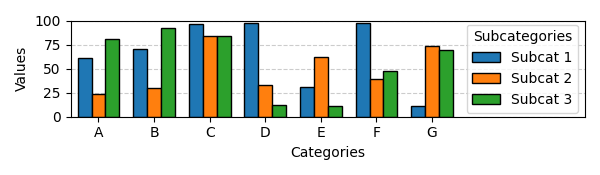
Figure 1. Visual representation of the project’s workflow using the template bar.

Curabitur suscipit urna ut felis vulputate, nec dictum orci vehicula. Mauris aliquet, nunc et dignissim tincidunt, urna est tempus lacus, ut suscipit ex tellus a ipsum. Donec pretium tempor justo vitae molestie. Fusce ullamcorper leo id purus sodales, at cursus felis lacinia. Pellentesque habitant morbi tristique senectus et netus et malesuada fames ac turpis egestas.

A Catchy Title for the First Section

Lorem ipsum dolor sit amet, consectetur adipiscing elit. Vivamus tincidunt lectus quis libero interdum, non facilisis sapien aliquet. Sed sit amet ex hendrerit, dignissim purus sit amet, blandit est. Integer nec mauris at dolor egestas volutpat. Quisque efficitur metus vitae dolor fermentum, quis varius neque consectetur.

Curabitur suscipit urna ut felis vulputate, nec dictum orci vehicula. Mauris aliquet, nunc et dignissim tincidunt, urna est tempus lacus, ut suscipit ex tellus a ipsum. Donec pretium tempor justo vitae molestie. Fusce ullamcorper leo id purus sodales, at cursus felis lacinia. Pellentesque habitant morbi tristique senectus et netus et malesuada fames ac turpis egestas.

Feature A

In this section, we introduce Feature A, a core component of the project that plays a pivotal role in achieving the overall goals. The importance of this feature stems from its ability to bridge critical gaps in existing workflows, deliver performance enhancements, and unlock new possibilities for visualization, analysis, or interactivity.
Feature B

Feature B is also important. In this section, we introduce Feature B, another core component of the project that plays a pivotal role in achieving the overall goals. The importance of this feature stems from its ability to bridge critical gaps in existing workflows, deliver performance enhancements, and unlock new possibilities for visualization, analysis, or interactivity.

Another Catchy Title for the Second Section

Template bar illustration
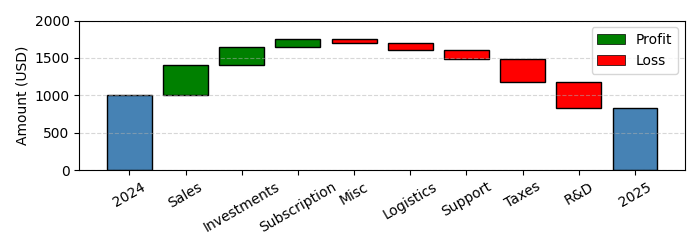
Figure 2. Waterfall chart, which shows the cumulative breakdown of changes (positive and negative) across different categories, illustrating how each step contributes to the final total.

Lorem ipsum dolor sit amet, consectetur adipiscing elit. Vivamus tincidunt lectus quis libero interdum, non facilisis sapien aliquet. Sed sit amet ex hendrerit, dignissim purus sit amet, blandit est. Integer nec mauris at dolor egestas volutpat. Quisque efficitur metus vitae dolor fermentum, quis varius neque consectetur. Curabitur suscipit urna ut felis vulputate, nec dictum orci vehicula. Mauris aliquet, nunc et dignissim tincidunt, urna est tempus lacus, ut suscipit ex tellus a ipsum. Donec pretium tempor justo vitae molestie. Fusce ullamcorper leo id purus sodales, at cursus felis lacinia. Pellentesque habitant morbi tristique senectus et netus et malesuada fames ac turpis egestas.

Another Catchy Title for the Third Section

Playfair 1801 chart
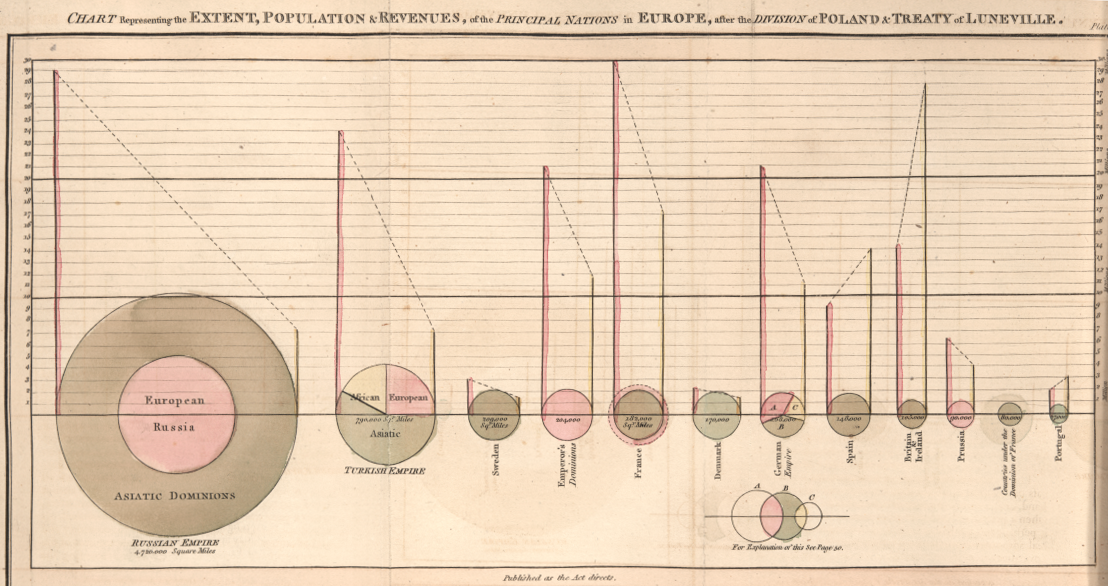
Figure 3. William Playfair's 1801 'Chart of the Extent, Population and Revenue of the Principal Nations of Europe.' The central pie displays each nation's share of European land area, while red and yellow radial bars show, respectively, population size and annual government revenue. First printed in The Statistical Breviary, it is widely regarded as the earliest known multi-slice pie chart and highlights the contrast between territorial extent, demographic weight, and fiscal power.

Lorem ipsum dolor sit amet, consectetur adipiscing elit. Vivamus tincidunt lectus quis libero interdum, non facilisis sapien aliquet. Sed sit amet ex hendrerit, dignissim purus sit amet, blandit est. Integer nec mauris at dolor egestas volutpat. Quisque efficitur metus vitae dolor fermentum, quis varius neque consectetur. Curabitur suscipit urna ut felis vulputate, nec dictum orci vehicula. Mauris aliquet, nunc et dignissim tincidunt, urna est tempus lacus, ut suscipit ex tellus a ipsum. Donec pretium tempor justo vitae molestie. Fusce ullamcorper leo id purus sodales, at cursus felis lacinia. Pellentesque habitant morbi tristique senectus et netus et malesuada fames ac turpis egestas.

Outro

This is the last section. In this part, we bring together all the ideas explored throughout the project, reflecting on what was learned, what worked well, and what challenges emerged. We revisit the core objectives, summarizing how each was addressed, and highlight the most significant insights that have arisen from the work. Moreover, we outline how the outcomes contribute to the broader field, what implications they may have for future research or real-world applications, and why these findings matter. In addition, this section proposes concrete next steps: further experiments, methods refinement, validation on new datasets, collaborative extensions, or deployment scenarios. We also discuss potential limitations, acknowledge open questions, and suggest areas that merit deeper investigation.

References and Data Sources

1. Black, Joe; Doe, Jane; and Lee, Maria. “Template Paper Title on Data Analysis.” Journal of Data Analysis & Visualization 30, no. 1 (2023): 100-120.

2. White, Chris; Green, Anna; and Kim, Sam. “Template Methods for Interactive Dashboards.” International Journal of Interactive Visualization 25, no. 2 (2022): 210-234.

3. Miller, Pat; Gomez, Sofia; and Zhang, Lin. “Template Techniques for Labels & Annotation in Multidimensional Graphs.” Computational Graphics & Data Systems 12, no. 3 (2024): 45-70.

4. Wright, Ben; Park, Soo; and O’Neil, Pat. “Template Approaches to Temporal Flow Visualization.” Decision Support & Data Analytics 14, no. 3 (2021): 300-320.